
Everyone who stores food eventually asks the same question: what does it really cost? The honest answer depends on what you are buying it for. If the goal is the cheapest possible calories, rice, beans and oats win by a mile. If the goal is food that is light, ready in minutes, tastes like dinner and sits sealed for decades, freeze-dried food earns its price. To put numbers on that, we priced a dozen real products on November 8, 2026 and converted each to the same unit: dollars per 2,000 calories, which is about one person’s food for one day by the general reference the FDA uses on Nutrition Facts labels. All the arithmetic is shown, and the things we could not verify are listed at the end.
The short version
- Dry rice, beans and oats cost roughly $0.63 to $1.85 per 2,000 calories. Nothing else comes close, as long as you can cook and have water.
- Canned food and MREs land between about $10 and $14. Canned chili and beans came in at $9.71 to $11.49 and a 12-meal MRE case at $14.00.
- Freeze-dried food ran from about $24 to $72 per 2,000 calories in our sample, depending on the item. Vegetables and pasta are at the low end, meats at the high end.
- Weight is where freeze-dried earns its keep: about 310 to 480 grams per 2,000 calories, versus 1,830 to 2,790 grams for canned food (which includes liquid).
- The smart plan is a mix: a cheap base of dry staples, some canned and MRE items, and freeze-dried food for quality, variety and the foods you cannot easily replace.
The comparison
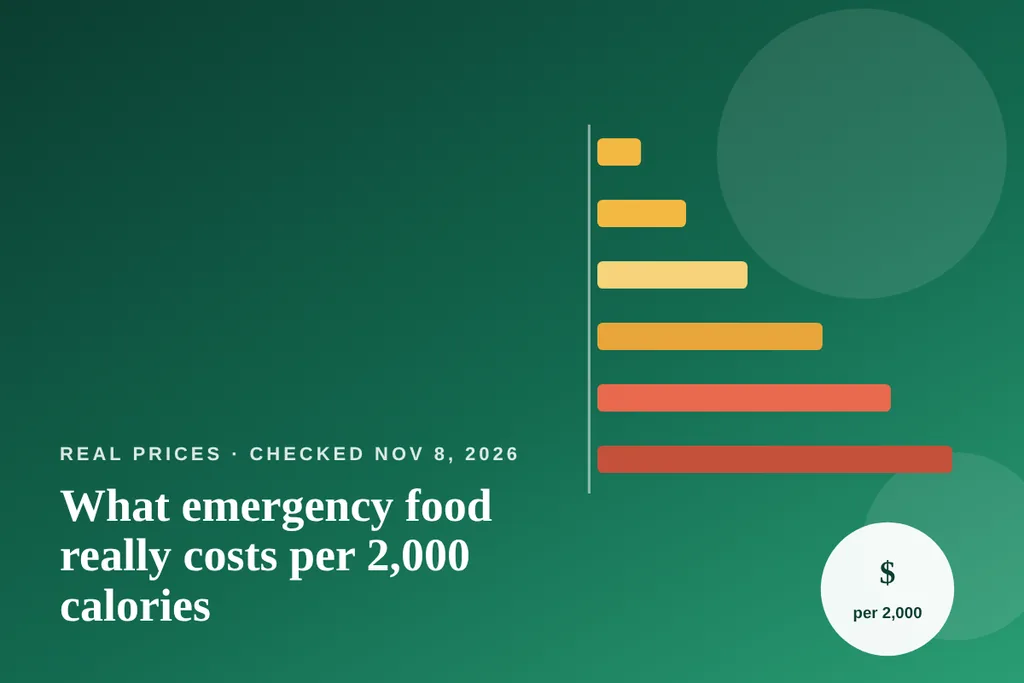
Each bar shows the price of 2,000 calories of that product. Calories come from the nutrition label, the manufacturer’s page or USDA data (details below), and prices are what we saw on November 8, 2026, before shipping and tax.
| Item | Store | Price | Total calories | Per 2,000 cal |
|---|---|---|---|---|
| White rice, 20 lb bag | Walmart | $10.36 | 33,112 | $0.63 |
| Black beans, dry, 4 lb | Walmart | $5.12 | 6,187 | $1.66 |
| Rolled oats, 42 oz | Walmart | $4.18 | 4,513 | $1.85 |
| Pinto beans, canned | Walmart | $1.53 | 315 | $9.71 |
| Chili with beans, canned | Walmart | $2.67 | 465 | $11.49 |
| Ready Harvest 1-Month Pack (dry staples) | Thrivalist | $364.86 | 61,260 | $11.91 |
| MRE, 12-meal case | Palmetto State Armory | $104.99 | 15,000 | $14.00 |
| Freeze-dried sweet corn, #10 can | Thrivalist | $29.39 | 2,420 | $24.29 |
| Freeze-dried cheese tortellini, bag | Freeze Dry Wholesalers | $34.95 | 2,304 | $30.34 |
| Mountain House pizza bowl, #10 can | Mountain House | $64.99 | 3,700 | $35.13 |
| Freeze-dried chicken dices, #10 can | Thrivalist | $79.99 | 3,080 | $51.94 |
| Freeze-dried turkey breast, bag | Freeze Dry Wholesalers | $36.65 | 1,020 | $71.86 |
How we calculated it. Cost per 2,000 calories = price ÷ total calories in the package × 2,000. For packaged foods, total calories = calories per serving × servings per container, from the label. For rice, beans and oats, we used the USDA FoodData Central calories per 100 grams (white long-grain rice 365, black beans 341, oats 379) times the package weight. For the MRE, the retailer gives an average of 1,250 calories per meal, which we multiplied by 12 meals. For Mountain House, we used its listed 10 servings of 370 calories. All of this was checked with code, not by hand.
What the numbers mean
Dry staples are in a class of their own
A 20-pound bag of rice at $10.36 contains about 33,000 calories, which is about 16 days of food for one person for about $10. Dry beans and oats are in the same range. Dry staples also have a long shelf life when stored well. The USDA’s FoodKeeper data gives white rice 2 years, dried beans 1 to 2 years and oatmeal 12 months in ordinary retail packaging, and those figures are not the 25-to-30-year claims for sealed, oxygen-free cans. Their limits are practical: they need water, time and a heat source, they are plain, and they are bulky in a bug-out situation.
Canned food is cheap and heavy
Canned pinto beans and canned chili cost $9.71 and $11.49 per 2,000 calories, and USDA’s shelf-stable guidance says low-acid canned goods such as beans, meats and stews keep for 2 to 5 years, with high-acid foods such as tomatoes and most fruits lasting 12 to 18 months. The trade-off is weight: about 1.8 to 2.8 kilograms per 2,000 calories, including the liquid in the can.
MREs are priced for convenience
The MRE case cost $14.00 per 2,000 calories on the retailer’s own average of 1,250 calories per meal. The USDA publishes a time-and-temperature chart for MREs: about 7 years at 60°F, 4 years at 80°F, 1.5 years at 100°F, and one month at 120°F. Where you store them matters more than the date on the box.
Freeze-dried food costs more because it is a different product
Freeze-dried vegetables and pasta cost $24 to $30 per 2,000 calories; freeze-dried meats cost $52 to $72. The product claims 25 to 30 years of shelf life sealed, it weighs a fraction of canned food, and it needs only water, with no cooking for many items. Some of that price reflects the processing, and some reflects how few calories vegetables and lean meat contain per serving. With meat, the protein is valuable but the calories are expensive.
That is why the rankings can mislead. Chicken dices at $51.94 per 2,000 calories are a poor way to buy calories and a good way to buy protein and flavor. Think of the comparison as pricing the calories, not the meal.
A worked example: two adults, 14 days
Two adults for 14 days need about 56,000 calories at 2,000 per person per day, which is 28 units of 2,000 calories. This is only to show scale; no one should eat a single item for 14 days:
| If all 56,000 calories came from… | Approximate cost |
|---|---|
| White rice | $18 |
| Dry black beans | $46 |
| Rolled oats | $52 |
| Canned pinto beans / chili | $272 / $322 |
| MRE | $392 |
| Freeze-dried sweet corn / tortellini | $680 / $849 |
| Freeze-dried chicken dices | $1,454 |
A realistic plan blends them. A base of rice, beans and oats could supply most calories for under $100 for two people for two weeks. Add canned vegetables and fruit, plus a few freeze-dried proteins, vegetables and fruits, and you get variety for a few hundred dollars. If you want a ready-made version with no shopping list, our bulk and variety packs page lists multi-month packs, and our food storage calculator turns people and months into quantities.
What cost does not capture
- Rotation. Canned food and dry staples need to be used and replaced; freeze-dried food is sealed for much longer if stored cool and dry. If you eat what you store and replace it, rotation costs you nothing; if you forget it, it costs you everything.
- Water and fuel. Dry staples need cooking water and heat. Freeze-dried meals need water, hot or cold depending on the item, so water is part of the cost of any plan. See how much emergency water to store.
- Weight and space. A car kit or go-bag cannot hold 1.8 kilograms of canned chili per day.
- Taste and morale. People in a stressful situation eat more of food they like. That has real value in a multi-week emergency.
- Shipping, sales and sold-out items. We excluded shipping and tax. Several Thrivalist packs and Mountain House pouches were sold out when we checked.
Where to start
- Buy the base first: a bag of rice, a bag of dry beans, oats, salt, and a way to cook and purify water.
- Add canned and shelf-stable ready-to-eat foods for days when you cannot or do not want to cook.
- Add freeze-dried foods for the gaps: proteins, vegetables, fruit and a few full meals. Start with sweet corn (#10 can, $29.39) or chicken dices (#10 can, $79.99) on Thrivalist, or browse our meats and proteins, vegetables and fruits pages.
- Test your plan. Cook a few meals from the pantry on a weekend. You will find what you actually like and what is missing.
What we could not verify
- Sweet corn servings: the nutrition label image shows 22 servings per can, while the can graphic on the same page says 20. At 20 servings the cost is $26.72 per 2,000 calories instead of $24.29. A previous label image on the page shows a smaller fill, so the can you receive may differ. We used the 22-serving label.
- Thrivalist 1-Month Pack: the 2,042 calories per day figure comes from the product page’s own claim (it was sold out on November 8), so it is a claim, not a measurement. The pack is dry staples, not freeze-dried.
- MRE calories: 1,250 calories per meal is the retailer’s stated average, not a per-item label, and no weight was listed.
- Canned chili: the manufacturer’s page lists “1 serving per container” for the 15-ounce can, which looks like a template error, so we computed total calories from the serving weight (270 calories per 247 grams) times the can’s 425 grams.
- Weights: freeze-dried and dry foods are dry weight, while canned weight includes liquid, so grams per 2,000 calories compares unlike things. Freeze-dried servings at Freeze Dry Wholesalers are listed on a rehydrated basis.
- Freeze-dried fruit and a complete-meal can from Thrivalist or Freeze Dry Wholesalers were not included because we could not find a comparable product with a label.
- Walmart prices are for a single Texas store; the 20-pound rice was a Rollback price ($10.36, normally $11.57), so rice at the non-sale 5-pound price of $3.52 costs $0.85 per 2,000 calories.
Frequently asked questions
What is the cheapest emergency food per calorie?
Dry staples. White rice came out around $0.63 per 2,000 calories, dry black beans around $1.66 and rolled oats around $1.85 in our November 2026 sample. They require water and cooking.
Is freeze-dried food worth the price?
Per calorie it is the most expensive option we tested, about $24 to $72 per 2,000 calories. It makes sense when weight, speed, variety, taste and very long sealed shelf life matter more than the lowest cost per calorie. Most households are best served by a mix.
How many calories per day should I plan for?
We use 2,000 per person per day because the FDA uses it as a general guide on Nutrition Facts labels. Individual needs vary with age, size and activity.
How long does canned food last compared with MREs and freeze-dried food?
USDA says low-acid canned goods last 2 to 5 years and high-acid canned goods 12 to 18 months. MRE life depends on temperature, from about 7 years at 60°F to one month at 120°F. Freeze-dried manufacturers claim 25 to 30 years for sealed product stored cool and dry.
Why did you include dry staples and a Thrivalist dry pack?
Because a fair comparison includes the cheap options. We earn a commission on Thrivalist and Freeze Dry Wholesalers links, which is why we list the cheaper choices that earn us nothing.
Sources
- USDA FSIS, Shelf-Stable Food Safety (last updated October 24, 2024): canned-goods shelf life and the MRE time-and-temperature chart.
- USDA FSIS, FoodKeeper data: pantry shelf life for rice, dried beans and oatmeal.
- USDA FoodData Central: white long-grain rice (FDC 168877), black beans (FDC 173734), oats (FDC 173904), and a branded chili with beans record (FDC 2671576).
- FDA, Calories on the Nutrition Facts Label.
- Product pages (checked November 8, 2026): Thrivalist sweet corn, Thrivalist chicken dices, Thrivalist 1-Month Pack, Freeze Dry Wholesalers tortellini, Freeze Dry Wholesalers turkey breast, Mountain House pizza bowl, US War Fighter MRE case, Hormel chili with beans, Bush’s pinto beans, and Walmart listings for rice, black beans and oats.
Thrive Freeze earns a commission when you buy through our Thrivalist or Freeze Dry Wholesalers links, at no extra cost to you. See our affiliate disclosure. This article is general preparedness and food-safety information, not medical or legal advice. Prices and stock were checked on November 8, 2026 and can change.