
When people ask which freeze-dried foods are best for long-term storage, the honest answer is this: the best long-term foods are the ones that store for 20 to 30 years, cover real calories and nutrition, and that your family will actually eat. Freeze-dried ingredients check every box. Because freeze-drying removes roughly 98 to 99% of the moisture through sublimation at low temperatures, then locks the food in sealed #10 cans or Mylar pouches with oxygen absorbers, you get shelf-stable staples that retain most of their nutrients and flavor for decades. Here is how to build a long-term supply that’s genuinely worth opening years from now.
What “Long-Term” Actually Means
“Long-term” is not a marketing word, it’s a measurable shelf life. A properly sealed #10 can or Mylar pouch with an oxygen absorber, stored in a cool, dark, dry place, will keep freeze-dried food good for 20 to 30 years. That’s the difference between a true preparedness pantry and a grocery-store stockpile that turns over every few months.
The science is simple. Microbes, enzymes, and oxidation all need moisture and oxygen to spoil food. Strip out almost all the water through freeze-drying, pull the oxygen out of the container with an absorber, and seal it, and there is very little left for spoilage to work with. That’s why freeze-dried ingredients dramatically outlast canned, dehydrated, or frozen alternatives.
The best long-term food isn’t the food with the most dramatic packaging, it’s the food you’ll rotate through, cook with, and replace, year after year, without it ever going to waste.
The Best Categories to Store Long-Term
A resilient pantry isn’t one product, it’s a balance across food groups. Here’s how the categories stack up.
Calorie Staples and Bulk Foods
Calories keep you going, so your foundation should be filling, versatile staples bought in volume. Bulk and variety packs are the most economical way to cover a lot of meals and a lot of days at once, and they give you a ready mix rather than a single ingredient. Start your foundation with our bulk and variety packs.
Proteins
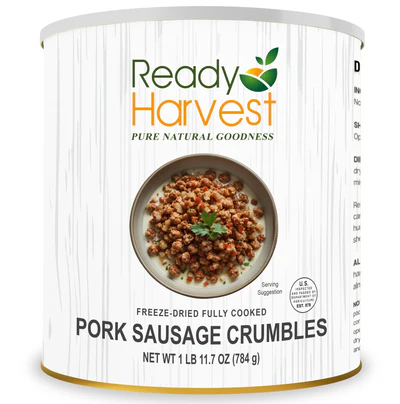
Protein is the category most people under-store, and it’s the hardest to improvise without. Freeze-dried meats rehydrate quickly and bring substance to soups, stews, casseroles, and skillet meals. Build out your protein supply from our freeze-dried meats.
Fruits and Vegetables
Long-term doesn’t have to mean bland. Freeze-dried fruits and vegetables hold their color, texture, and most of their nutrients, so they keep meals varied and appetizing. Vegetables drop straight into anything simmering; fruits are great rehydrated or eaten dry as a snack.
Dairy and Eggs
These are the “force multipliers” of a long-term pantry. Freeze-dried eggs, cheese, butter powder, and milk turn plain staples into real meals, baked goods, and breakfasts. Don’t overlook our dairy and eggs selection.
- Calorie staples / bulk: the foundation, bought in volume
- Proteins: the most-overlooked, hardest-to-replace category
- Fruits & vegetables: nutrition, variety, and morale
- Dairy & eggs: turn staples into actual meals
Build Your Freeze-Dried Pantry
Hand-picked categories for this guide — sealed for 20–30 years, ready when you are.
How #10 Cans and Oxygen Absorbers Achieve 20–30 Years
The packaging is doing real work. Here’s the chain that gets you to decades of shelf life:
- Freeze-drying removes nearly all the moisture without cooking the food, preserving structure, color, and most nutrients.
- A #10 can or Mylar pouch provides a rigid or high-barrier seal that blocks light, air, and pests.
- An oxygen absorber scavenges the residual oxygen inside, halting the oxidation that causes rancidity and nutrient loss.
- Cool, dark, dry storage keeps the contents stable for the long haul.
Remember that the clock changes once you open a container. A sealed pouch lasts decades; an opened one is good for months, so reseal tightly and use opened cans within a reasonable window.
How Much Should You Store?
A common starting target is roughly 2,000 calories per person per day. Multiply that by the number of people and the number of days you want to cover, and you have a real number to build toward. Rather than guess, run your own household through our supply calculator, it turns people and timeframe into a concrete shopping list.
A practical way to scale up:
- Starter (1–2 weeks): a few variety packs plus water
- Intermediate (1–3 months): add proteins, dairy, eggs, and more produce
- Long-term (6–12 months): round out calories with bulk staples and broad variety
Rotation: The One Habit That Matters
Even 30-year food benefits from a simple “first in, first out” system. Cook with your freeze-dried ingredients now and then, note what your family likes, and replace what you use. Rotation keeps your supply fresh, your skills sharp, and your inventory honest, so when you need it, there are no surprises.
Ready to build a pantry that lasts decades, not months? Start with our bulk and variety packs for your foundation, add meats and dairy and eggs for complete meals, and use the supply calculator to size it to your household. Browse the full shop and start storing smarter today.
Designing a One-Year Food Plan in Four Layers
A year of food storage sounds enormous when you picture it all at once. It is easier when you split it into layers and add one layer at a time. Each layer has a job, and freeze-dried food is one of them, not the whole plan.
The math for one person
Start with the usual planning figure of about 2,000 calories a day, which is a rough number for an adult. That is about 730,000 calories a year, or about 60,000 a month. For a household of four, multiply by four, then adjust for kids, teens, and activity.
Example split for one person (adjust it to your tastes and budget):
- Layer 1, staples (about 55 percent): 730,000 times 0.55 is about 400,000 calories. At roughly 1,600 calories a pound for dry rice, beans, and pasta, that is about 250 pounds.
- Layer 2, fats, sugars, and spreads (about 20 percent): cooking oil, nut butters, sugar or honey. About 146,000 calories.
- Layer 3, freeze-dried proteins, dairy, fruits, and vegetables (about 15 percent of calories, but a bigger share of variety): about 110,000 calories. Use the calories on each label.
- Layer 4, comfort and morale (about 10 percent): coffee, tea, sweets, snacks, and kids' favorites. About 73,000 calories.
The freeze-dried layer is small by calories and large by function. It supplies protein, produce, and flavor that staples cannot. Do not judge it by calorie cost alone, and do not skip it because the staples cover your numbers.
What each layer is for
- Staples keep everyone fed cheaply. They are the easiest layer to build and the one to start with if money is tight.
- Fats and sugars raise calories without adding much bulk, and they make plain food taste better.
- Freeze-dried foods turn staples into meals. Proteins, vegetables, fruits, and dairy and eggs are the usual choices.
- Comfort foods protect morale. A cup of hot chocolate on a cold, dark night is worth more than its calories suggest.
A 12-month buying rhythm
The idea is one theme a month, so the work is small and the shelves fill in a useful order.
- Month 1: Water, a manual can opener, a way to cook, and a 72-hour supply of no-cook food.
- Month 2: First round of staples: rice, beans, oats, pasta.
- Month 3: Fats, salt, sugar, bouillon, spices, and powdered or shelf-stable milk.
- Month 4: Freeze-dried proteins, such as chicken, beef, and eggs. Order a small amount first and cook with it.
- Month 5: Freeze-dried vegetables, including onions and potatoes.
- Month 6: Freeze-dried fruits and dairy. Do a half-year check by cooking from your storage for a full weekend.
- Month 7: Second round of staples.
- Month 8: Comfort and morale foods, and favorites for each family member.
- Month 9: Fill the gaps your cooking weekend revealed, such as more of what you ran out of.
- Month 10: Water upgrades: filters, extra containers, and a purification method.
- Month 11: Third round of staples, and backup fuel stored safely.
- Month 12: Audit. Update the inventory, rotate older items forward, and decide what to build in year two.
Decision rules for adjusting the plan
- If your budget is tight, do staples and water first and add freeze-dried food in small amounts.
- If storage space is limited, shift toward freeze-dried items, which are lighter and denser per shelf foot.
- If you live where storms or winter outages are common, pull water and cooking forward to the first two months.
- If you have kids or picky eaters, move comfort foods up to month 3 or 4.
- If someone has an allergy or special diet, build that layer first and keep it separate and labeled.
Making the monthly buy simple
Choose a regular day, such as the first of the month. Set a fixed amount, and treat it like a bill. Keep a running list of items the family used up so the next order covers real needs.
When you order online, check each seller's shipping terms. Thrivalist, the retailer this site links to, states free shipping to the lower 48 states on orders over $99 and offers Subscribe & Save, so a monthly order that clears the threshold can reduce shipping costs. Verify current terms at checkout. Its monthly special is listed on our monthly deals page. Food items are listed as non-returnable in its FAQ, so keep the early orders modest until you know what your family likes.
Common mistakes
- Buying all the freeze-dried food in one month, then running out of money for staples.
- Skipping water and cooking gear because they are less exciting than food.
- Never cooking from storage until the day you need it.
- Buying duplicates of what you love and nothing for variety. Aim for many different items, not just a lot of one.
- Forgetting to rotate. A plan that is never touched becomes a closet of unknowns.
Questions to ask next
Do I really need a full year?
Not at all. Most households get most of the benefit from one to three months. A year is a long-term goal, and the layers work at any size. See the comparison of 1-month, 6-month and 1-year plans to decide where to stop.
What if I fall behind?
Skip a month and keep going. The order matters more than the schedule. Run your numbers in the supply calculator whenever your household changes.