Best Emergency Food Kits for Families 2026: 72-Hour to 1-Year Supply Compared

If you are shopping for an emergency food kit for a family, you have already realized the same thing we did when we started: the marketing is loud, the math is suspicious, and almost every brand uses different serving sizes that make direct comparison nearly impossible. We have spent the past two years buying, eating, and storing emergency food kits across every major U.S. brand, and below is the honest, opinionated guide to what is actually worth buying in 2026.

This guide focuses specifically on family-sized kits—four-person households, generally—rather than single-adult survival rations or commercial bulk-buyer warehouses. We cover 72-hour, 1-week, 1-month, 3-month, and 1-year supply tiers, and we are blunt about which kits actually deliver the calories they advertise versus which ones are stretching the math.

Quick Verdict: Best Kits by Use Case

Best 72-hour grab-and-go kit: Mountain House Just-In-Case 3-Day Bucket per person, scaled to family size. Pricier than competitors but the food is genuinely good and morale matters when you are actually using the kit. Best 1-month family kit: Augason Farms 30-Day 4-Person bucket—best per-calorie value at this tier and decent variety. Best 3-month kit: ReadyWise 90-day pail combined with rice and beans bulk—ReadyWise alone is light on calories per day but supplemented works. Best 1-year kit: Augason Farms or My Patriot Supply 1-year 4-person packages—both deliver roughly the same calorie density at similar prices. Best premium upgrade: Thrive Life Pantry Pack or Mountain House Classic Bucket assortment for households that already store basics and want better-tasting variety.

The Calorie Math: Read Labels Carefully

Before we go brand-by-brand, the most important thing to understand about emergency food kits is the calorie math. Brands advertise kits in “days” or “person-days,” but the underlying serving size and calorie count varies wildly. A “30-day kit” from one brand might provide 1,200 calories per day; from another, 2,000. A 1,200-calorie-per-day diet is a starvation diet for an active adult.

The FEMA recommendation for emergency planning is 2,000 calories per adult per day. The military MRE standard is 1,200 calories per ration with three rations per day, totaling 3,600. We use 2,000 calories per adult per day as our baseline for evaluating kits, and we ignore “person-days” math that assumes children, sedentary adults, or short-term emergency-only rationing.

By that standard, here is the rough reality:

Augason Farms kits typically deliver 1,500-1,800 calories per person-day at their advertised count. Mountain House kits deliver 1,800-2,200. ReadyWise is the most aggressive with marketing math—some of their kits provide as few as 1,000-1,200 calories per person-day at advertised count. Valley Food Storage and My Patriot Supply typically deliver 1,400-1,800. Thrive Life sells pantry-style by-the-can rather than complete kits, so the math depends entirely on what you build.

Treat advertised “30-day” kits as 21-25 day kits for genuinely sustaining adults, and you will be roughly correct.

72-Hour Family Kits

The 72-hour kit is the disaster-bag kit—the food you grab when you leave the house quickly because of a hurricane evacuation, wildfire, earthquake, or extended power outage. Quality matters more here than per-ounce price because you are eating this food in stress and possibly displaced from home, and morale is real.

Mountain House Just-In-Case buckets contain enough variety that you will not get sick of the same flavor on day three, and the food genuinely tastes good. Buy one bucket per family member rather than scaling down a larger kit. ReadyWise has a similar 3-day product but at lower calorie density. Augason Farms makes a 72-hour kit that is the cheapest option but has notable cardboard-flavor entrees that are hard to enjoy in stress conditions.

1-Week Family Kits

The 1-week tier is where most families should start if they are building from zero. Power outages and short-term displacement events often resolve within 5-7 days, and a 1-week supply of real food beats a longer supply of food you cannot stomach.

The Augason Farms 1-Week 4-Person bucket is the value pick at roughly $200-$280 depending on sales. Mountain House does not sell a true 1-week 4-person kit but combinations of their 3-day buckets get you there for roughly $400-$500 at much higher quality. ReadyWise and Valley Food Storage both make 1-week kits—ReadyWise is heavily marketed but the calorie math is light; Valley Food Storage is a genuinely solid kit that is often overlooked. We give Valley Food Storage a slight edge over ReadyWise at this tier for honest calorie counts.

1-Month Family Kits

This tier is for households worried about extended grid-down events, multi-week supply chain disruptions, or quarantine-style situations. At 1 month for 4 people, you are buying meaningful food—120 person-days at proper 2,000-calorie sustenance is a real commitment.

Augason Farms 30-Day 4-Person Pail is the dominant value pick at roughly $400-$500. The variety is decent, the calorie math is honest by industry standards, and the shelf life is the standard 25-year claim. My Patriot Supply offers a similar product at similar pricing, with the trade-off being slightly better entree variety but lower calorie density per serving than Augason. Mountain House at this tier is excellent but expensive—roughly $1,200-$1,500 to assemble equivalent calories from their classic buckets. ReadyWise 1-month is in the $500-$650 range but again with the lightest calorie math of the major brands.

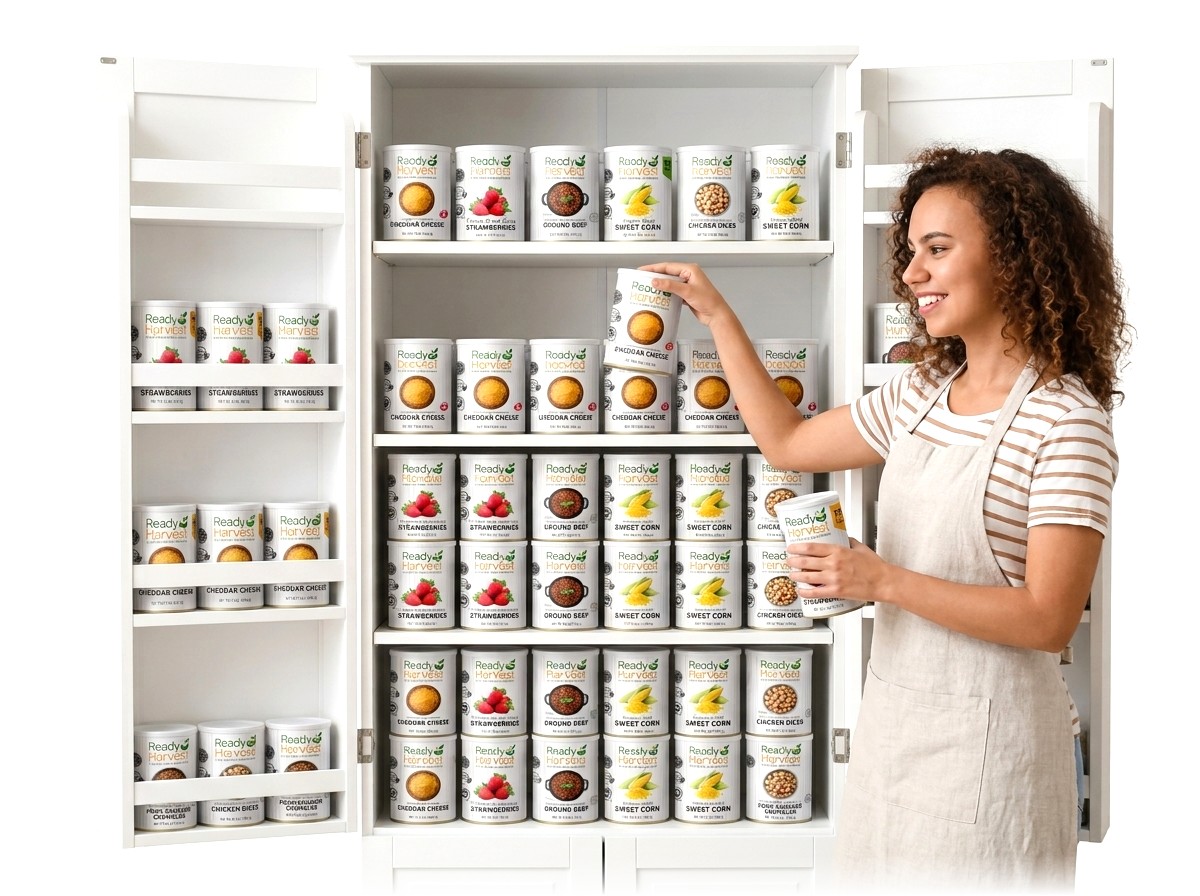
For households that already have rice, beans, and bulk staples, supplementing with a Thrive Life Pantry Pack of freeze-dried meats, vegetables, and dairy is often a better strategy than buying a complete kit—you get more variety and better individual ingredients at similar per-day prices.

3-Month and 1-Year Family Kits

At these tiers, you are no longer buying single buckets—you are buying pallets and dedicating storage closets or basements. Per-calorie price drops at this scale, but so does practical accessibility—these are not kits you are casually rotating into the family meal plan.

The 3-month tier from major brands costs roughly $1,200-$2,000 for 4 people. ReadyWise and My Patriot Supply both run frequent sales that make this tier surprisingly affordable. The 1-year tier ranges from $4,000 to $8,000 for 4 people depending on brand and calorie density—Augason Farms and My Patriot Supply are the practical value leaders, with Mountain House at the premium end ($10,000+) for households that prioritize taste and variety over cost.

An important honest note about 1-year kits: most families do not actually use them. They sit in storage, get forgotten, and eventually approach their shelf-life expiration with significant food still uneaten. We genuinely think most households are better served by a 1-month kit plus regular rotation of rice, beans, canned goods, and water than by a 1-year shrink-wrapped pallet sitting in a basement.

Brand-by-Brand Honest Take

Augason Farms: Best per-calorie value across most tiers. Decent flavor, decent variety, packaged in mylar and #10 cans with industry-standard 25-year shelf-life claims. The category leader for households on a budget.

Mountain House: Best food quality and best entree flavor in the industry. Most expensive per calorie. Best for 72-hour kits and short-duration scenarios where morale matters. Excellent for backpacking and camping in addition to emergency use.

ReadyWise: Heavily marketed, often discounted, but lightest calorie math in the category. Read serving sizes carefully and assume their advertised “30-day” kit is closer to 18-22 days at sustaining calories. Decent flavor at the price point.

Valley Food Storage: Underrated mid-tier brand. Honest calorie counts, decent variety, often overlooked because the marketing budget is smaller than ReadyWise or Patriot Supply. Worth comparing for 1-week and 1-month kits.

My Patriot Supply: Strong 3-month and 1-year kits, similar pricing to Augason Farms with slightly better entree variety. Aggressive marketing and many discount cycles—rarely worth paying full price.

Thrive Life: Pantry-style direct-to-consumer rather than kits. Excellent individual ingredients (freeze-dried chicken, beef, cheese, vegetables) that integrate into normal cooking. Best for households that already cook from scratch and want emergency food they will actually eat in normal life.

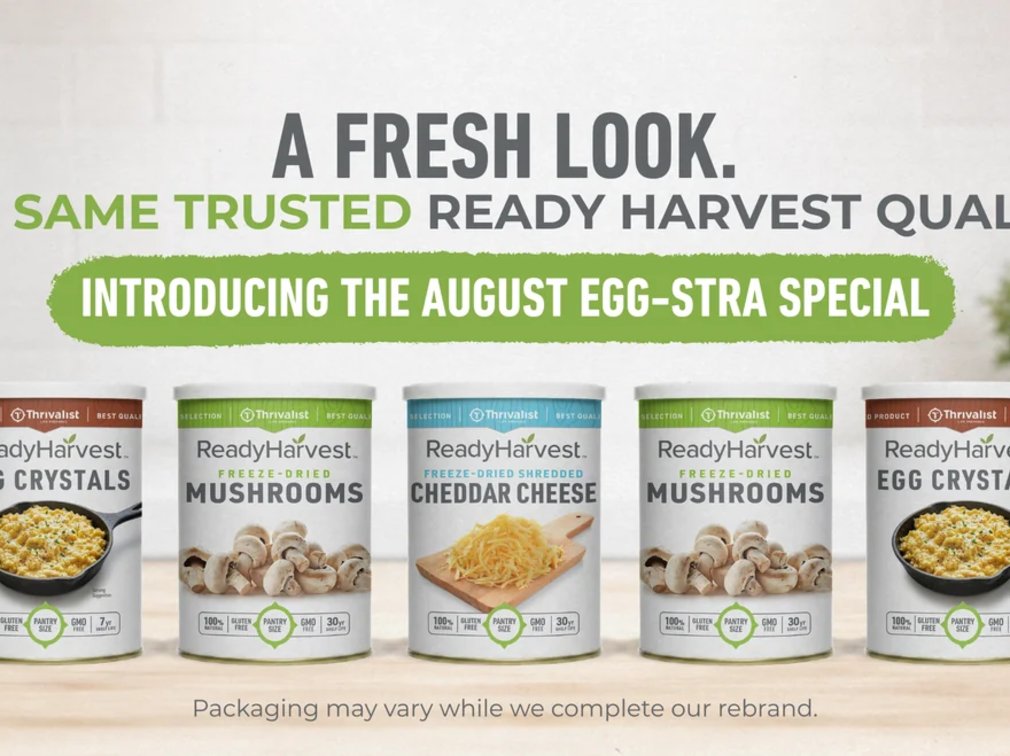
Thrivalist: Newer entrant with a focus on pouch-format meals and individual freeze-dried ingredients. Quality is good and the bundle deals on fruits and meats are competitive. See current Thrivalist bundles for current pricing.

How to Store Emergency Food Kits

The shelf-life claims of 25-30 years assume storage in cool, dry, dark conditions below 70°F. A finished basement is ideal. A garage in a hot climate is the worst common storage location—temperatures above 90°F roughly cut shelf life by half. An attic is even worse.

If your only available storage is a hot garage, we recommend treating the food as 5-10 year storage rather than 25-year and rotating accordingly. Kits stored in conditioned interior spaces will easily make their advertised shelf life.

Mylar pouches and #10 cans both seal effectively. The most common storage failure we see is people opening kits to inspect contents and not resealing properly—an opened pouch in humid conditions has a useful life of weeks to months, not years.

Water Is the Bigger Problem

Honest aside that almost no kit-marketing materials emphasize: water is a bigger emergency-planning problem than food for most families. The standard recommendation is 1 gallon per person per day for drinking and basic hygiene. A 4-person family needs 28 gallons for a 1-week supply—that is meaningful storage. Most freeze-dried meals also require water to rehydrate, so the calorie math of an emergency food kit only works if you have water to make it.

If you are building emergency supplies from zero and have $500 to spend, we would put $200 into a 1-week food kit and $300 into water storage (5-gallon containers, water filter, water purification tablets) before scaling up further. A pantry full of food and no water is a real problem.

The Bottom Line

For most families starting from zero, the right first move is a 1-week 4-person kit (Augason Farms or Valley Food Storage), supplemented with stored water and basic shelf-stable groceries the family actually eats. From there, scale to 1-month if your situation warrants it, and consider 3-month only after you have water storage, alternative cooking method, and basic medical supplies handled.

The biggest mistake we see is families buying a 1-year kit as their first emergency-prep purchase. It is enormously expensive, takes substantial storage space, and most of it sits unused for years. Build the foundation first—1 week of food, 2 weeks of water, basic medical and lighting—then scale up only as needed.

Quality matters more than quantity when you actually need the food. A real 7-day supply of food you will eat is more useful in a real emergency than a paper 30-day supply you cannot stomach.